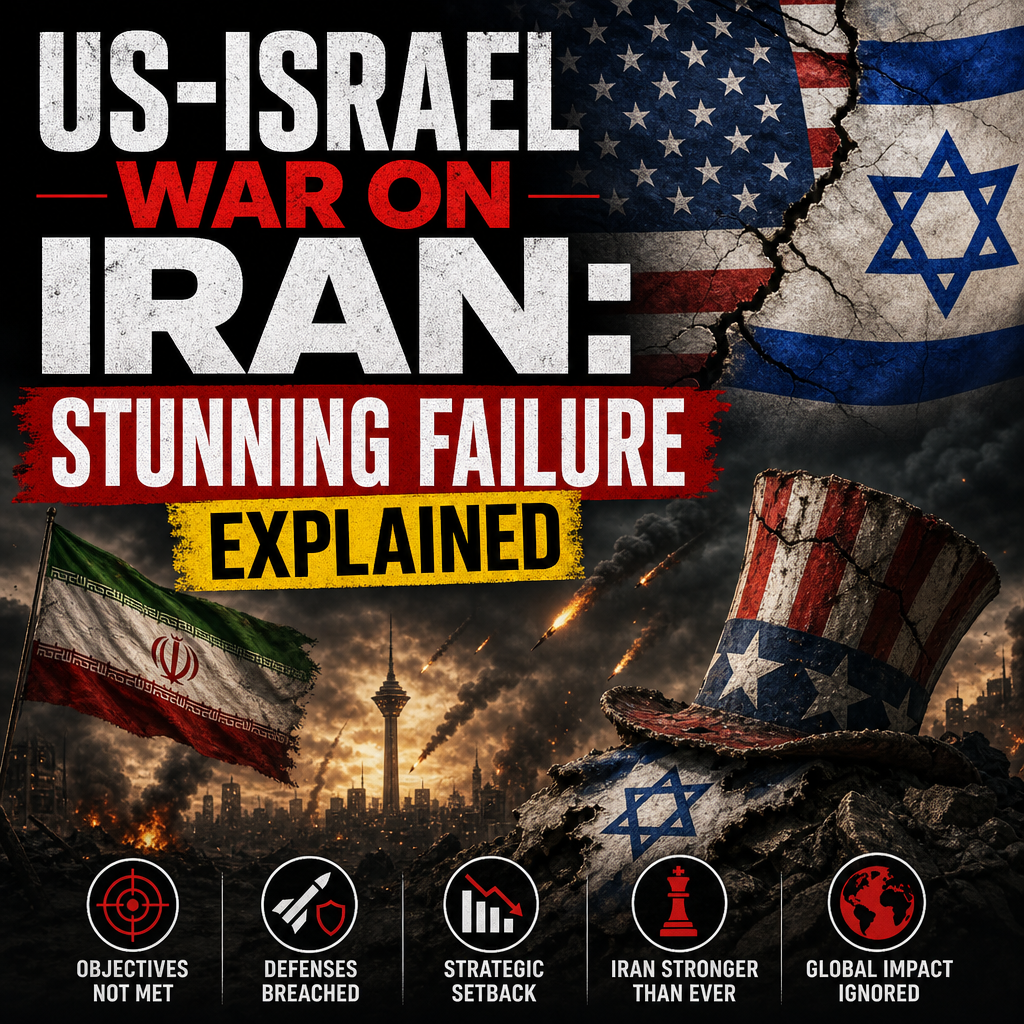
US-Israel War on Iran: Stunning Failure Explained


US-Israel war on Iran has exposed a hard truth that many policymakers, analysts, and regional observers have warned about for years: military pressure can damage Iran, but it is far harder to force a clean political outcome. Across coverage from different newsrooms, the picture that emerges is not one of simple victory or defeat, but of a campaign constrained by geography, deterrence, and the danger of escalation.
At the center of the debate is a basic mismatch between aims and tools. If the goal was to break Iran’s nuclear and missile capabilities, degrade its regional networks, or coerce it into major concessions, then the results look far less decisive than the rhetoric often suggests. If the aim was instead to signal resolve, reassure allies, and impose costs, then the effort may be seen as more successful. That split explains why the same events can be described as either a strategic setback or a controlled show of force.



US-Israel war on Iran: why military power hits a ceiling
The strongest argument against the idea of a clean military win is that Iran is not a conventional target. It is a large state with layered defenses, dispersed assets, and deep experience in absorbing pressure while avoiding outright collapse. Airstrikes or covert operations can destroy facilities, but they rarely eliminate the underlying knowledge, networks, or political will that keep a program alive.
That is one reason many analysts have long cautioned that bombing alone cannot solve the Iran problem. Even if specific sites are hit, the more likely outcome is adaptation: hardened infrastructure, relocation of critical assets, and accelerated pursuit of redundancy. In practical terms, that means the damage may be real but temporary, while the strategic consequences can last much longer.




Several themes recur across reporting from international outlets:
– Deterrence cuts both ways: Iran can retaliate directly or through aligned groups, making any attack a regional risk rather than a contained event.
– Escalation is difficult to control: Once strikes begin, each side must decide whether to absorb, answer, or widen the conflict.
– Civilian and regional spillover matters: Neighboring states, shipping routes, energy markets, and global diplomacy all become part of the battlefield.
– Regime change is not a credible short-term outcome: External force has rarely produced stable political transformation in the Middle East.
This is why the term “failure” may be too broad if it implies nothing was achieved. But it is also too generous if it suggests the campaign accomplished a decisive strategic shift. More likely, the effort produced mixed tactical effects while confirming how difficult it is to coerce Iran into submission.
What different newsrooms emphasize
The broad contours of the story look different depending on the editorial lens.
Some coverage, including outlets that are sharply critical of US and Israeli policy, frames the conflict as proof that coercion is self-defeating. In that reading, the strikes demonstrate overconfidence, expose the limits of Western firepower, and risk unifying domestic support inside Iran. The emphasis is on blowback: when external pressure rises, so does the incentive for Tehran to double down.
By contrast, reporting from mainstream international broadcasters tends to focus more on the balance of risks and diplomatic pressure. That approach often highlights concern over escalation, the possibility of wider regional war, and the need for off-ramps. The message is less ideological and more cautionary: even limited military action can trigger consequences that outlast the original objectives.
Middle Eastern coverage, especially from regional networks, often adds another layer: the war is not only about Iran and Israel, but about the future of deterrence across the entire region. For many audiences there, the critical question is whether diplomacy still has room to work once weapons are used. The answer is usually framed as uncertain, with a strong sense that trust has already been badly damaged.
Why a “stunning failure” can still look like momentum
If the campaign appears to have failed, why do leaders sometimes continue to talk as if pressure is working? The answer is political as much as military.
Domestic messaging matters
For governments in Washington or Jerusalem, projecting strength can be as important as achieving a perfect battlefield result. Leaders may need to show voters, allies, and rivals that they acted decisively. In that sense, even a limited strike can be presented as proof of seriousness.
Deterrence is often judged subjectively
Strategic success is not measured only by destroyed assets. It is also measured by whether the other side feels constrained. If Tehran pauses, disperses assets, or recalculates its response, supporters of the campaign may call that a win. Critics, however, point out that restraint is not surrender.
Escalation can be mistaken for effectiveness
A flurry of missile launches, intercepted attacks, and diplomatic panic can create the appearance of momentum. But chaos is not the same as progress. In conflicts like this, the public may see movement while the strategic picture remains stubbornly unchanged.
The real lesson: no side gets everything it wants
The clearest conclusion from the reporting is that neither side controls the outcome fully. Iran cannot assume immunity from pressure, and Israel and the United States cannot assume that force will neatly reshape Iranian behavior. That is what makes the current phase so dangerous: each player has incentives to act, but none has a guaranteed path to success.
There are three uncomfortable possibilities that emerge from the evidence:
1. The military campaign achieves only partial damage, not strategic reversal.
2. Iran responds in ways that raise the cost of further escalation.
3. Diplomacy becomes harder, not easier, because trust erodes after each round of force.
That does not mean diplomacy is dead. It means it is weaker, more fragile, and more dependent on outside actors than before. If there is a way out, it probably runs through indirect talks, regional mediation, and mutual backchanneling rather than open confrontation.
In the end, the most balanced reading is this: the US-Israel confrontation with Iran has shown the limits of military power in a complex regional conflict. It may have inflicted damage, signaled resolve, and shaped public narratives, but it has not produced a clean, lasting solution. That is why the story is best understood not as a triumph or a total failure, but as a warning. In a conflict built on deterrence, symbolism, and high stakes, even a “successful” strike can still leave the larger problem intact.